
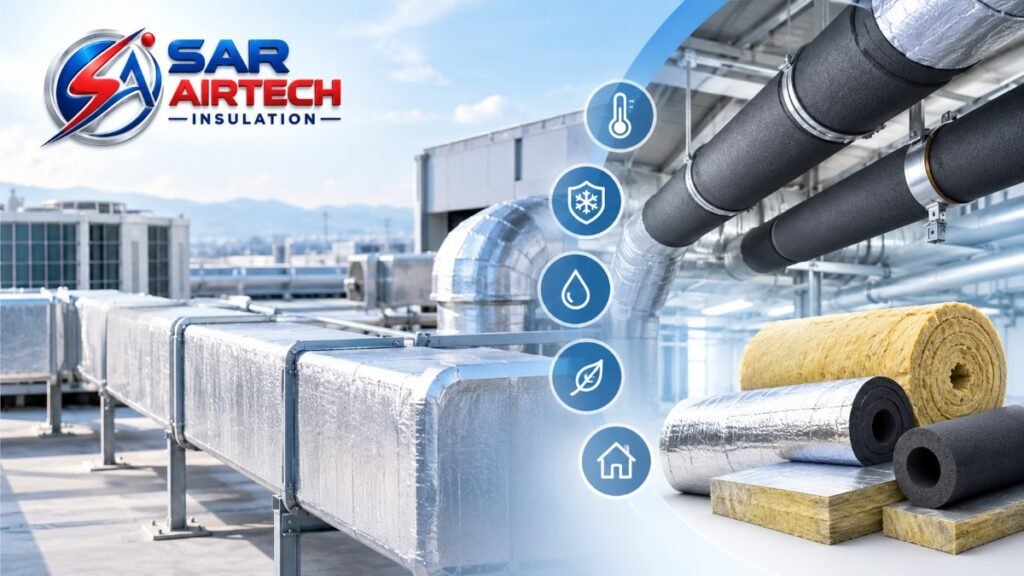
Heating, ventilation, and air conditioning (HVAC) systems play an important role in maintaining comfortable and controlled indoor environments. Whether it is a commercial building, manufacturing facility, office, hospital, or industrial unit, an HVAC system needs to operate efficiently to deliver the desired temperature and air quality.
One important part of an HVAC system that is sometimes overlooked is insulation. Proper insulation helps control heat transfer, reduce energy losses, prevent condensation, and maintain more consistent indoor temperatures.
But how exactly does HVAC insulation work, and why is it so important?
What Is HVAC Insulation?
HVAC insulation is a protective layer installed around components such as air ducts, chilled water pipes, hot water pipes, refrigeration lines, and other parts of an HVAC system.
Its main purpose is to reduce unwanted heat transfer between the HVAC system and its surrounding environment.
For example, when cool air travels through a duct in a warm area, heat from the surroundings can enter the duct. Without proper insulation, the air inside the duct may become warmer before reaching its destination.
Insulation creates a thermal barrier that slows down this heat transfer and helps the HVAC system maintain the required temperature.
How Does HVAC Insulation Work?
Heat naturally moves from a warmer area toward a cooler area. HVAC insulation works by slowing down this movement.
Most insulation materials contain tiny air spaces or have a structure that provides resistance to heat flow. When installed around an HVAC component, the insulation reduces the rate at which heat can pass through the surface.
For example:
Without insulation:
Warm surroundings → Duct surface → Cool air inside duct
Heat can enter the duct more easily, increasing the cooling load.
With insulation:
Warm surroundings → Insulation layer → Duct surface → Cool air
The insulation acts as a barrier and significantly reduces the amount of heat reaching the duct.
The same principle applies to heating systems. If hot air or hot water is travelling through a system, insulation helps prevent that heat from escaping into the surrounding environment.
Why Is HVAC Insulation Important?
Proper insulation provides several benefits to an HVAC system. These benefits are not limited to energy savings; insulation can also contribute to system performance, indoor comfort, and equipment protection.
1. Helps Reduce Heat Transfer
One of the primary functions of insulation is to control heat transfer.
In a cooling system, insulation helps prevent heat from entering chilled ducts or pipes. In heating applications, it helps prevent heat from escaping.
This allows the HVAC system to maintain the desired temperature more effectively.
2. Supports Energy Efficiency
When an HVAC system loses less heating or cooling energy, it does not need to work as hard to maintain the required conditions.
For example, poorly insulated ducts carrying conditioned air through hot areas can gain heat before the air reaches the room. The system may then need to operate for longer periods to compensate.
Proper insulation helps reduce these losses and can support more efficient operation.
3. Helps Prevent Condensation
Condensation is a common concern with cold HVAC surfaces.
When a cold duct or pipe comes into contact with warm and humid surrounding air, moisture can form on the surface if the surface temperature falls below the dew point.
Over time, condensation can cause:
- Water dripping
- Moisture damage
- Corrosion
- Ceiling or wall damage
- Mold and microbial growth in suitable conditions
A properly selected and installed insulation system helps keep the outer surface temperature above the condensation point and reduces the risk of moisture formation.
4. Helps Maintain Indoor Comfort
An HVAC system is designed to deliver air at a particular temperature. If significant heat is gained or lost while the air is travelling through the ductwork, the final air temperature may differ from the intended temperature.
Good insulation helps maintain more consistent air temperatures throughout the distribution system.
This is particularly important in large buildings where ducts may travel considerable distances through areas with different temperatures.
5. Helps Improve HVAC System Performance
An HVAC system consists of multiple interconnected components. If one part of the system experiences unnecessary heat gain or heat loss, the overall system can be affected.
Proper insulation helps the system operate under more controlled thermal conditions.
This can contribute to:
- More stable temperatures
- Reduced thermal losses
- Better air distribution
- Improved operating efficiency
- More consistent system performance
Where Is HVAC Insulation Used?
HVAC insulation is used in different parts of heating, ventilation, and air conditioning systems depending on the application.
Air Ducts
Duct insulation is commonly used to reduce heat gain or heat loss as conditioned air travels through the building.
It is particularly useful when ducts pass through unconditioned areas such as:
- Roof spaces
- Service areas
- Plant rooms
- False ceilings
- External or semi-exposed areas
Chilled Water Pipes
Chilled water systems use cold water to transfer cooling energy. These pipes require suitable insulation to reduce heat gain and control condensation.
The insulation system must be properly sealed because gaps or damaged sections can allow moisture to reach the pipe surface.
Hot Water and Heating Pipes
Hot water pipes and heating systems can also benefit from insulation. In these applications, insulation helps reduce heat loss and keeps thermal energy where it is needed.
Refrigeration and Air Conditioning Lines
Refrigerant pipes can require insulation to help control temperature and prevent condensation, depending on the application and system design.
Common Materials Used for HVAC Insulation
Different insulation materials are selected according to factors such as operating temperature, location, moisture exposure, fire requirements, mechanical conditions, and project specifications.
Some commonly used materials include:
Rockwool
Rockwool is a mineral wool insulation material known for its thermal and fire-resistant properties. It is widely used in industrial and building applications where thermal insulation and fire performance are important considerations.
Glasswool
Glasswool is made from fine glass fibers and is commonly used for thermal and acoustic insulation. It can be used in various HVAC and building applications depending on the system requirements.
Elastomeric Insulation
Elastomeric insulation is a flexible closed-cell material frequently used around chilled water pipes and refrigeration lines. Its closed-cell structure can provide good resistance to moisture when properly installed.
Other Insulation Systems
Depending on the project, other materials and systems may also be used. The correct choice depends on the HVAC design, operating conditions, environmental exposure, and applicable standards.
Why Proper Installation Matters
Selecting a good insulation material is only one part of the process. Installation quality is equally important.
Even a high-performance insulation material may not work effectively if it is poorly installed.
Common installation issues include:
- Gaps between insulation sections
- Damaged insulation
- Improper joints
- Insufficient thickness
- Poor sealing
- Compression of insulation
- Incorrect installation around fittings and supports
- Inadequate protection from moisture
For example, a small uninsulated section on a chilled water pipe can become a point where condensation develops. Similarly, gaps around duct insulation can reduce the overall thermal performance of the system.
Therefore, insulation should be installed continuously and carefully, with particular attention given to joints, bends, supports, valves, and other difficult areas.
Choosing the Right HVAC Insulation
There is no single insulation material that is suitable for every HVAC application.
The selection should consider several factors, including:
Operating Temperature:
The insulation must be suitable for the temperature range of the system.
Moisture Exposure:
Areas exposed to humidity or condensation may require insulation systems with appropriate moisture resistance and vapor control.
Fire Requirements:
The material should meet the fire-performance requirements applicable to the building and project.
Location:
Indoor, outdoor, industrial, and plant-room installations may have different requirements.
Insulation Thickness:
The required thickness depends on the application, operating conditions, and desired thermal performance.
Mechanical Protection:
In areas where insulation may be exposed to physical damage, additional protective measures may be required.
HVAC Insulation in Industrial Buildings
Industrial facilities often have complex HVAC requirements. Manufacturing areas, warehouses, laboratories, offices, and utility spaces can have different temperature and ventilation requirements within the same facility.
In such environments, properly designed and installed insulation can help control thermal losses across the HVAC network.
This becomes particularly relevant in industrial areas such as Baddi, where manufacturing facilities may operate HVAC systems across production areas, offices, storage spaces, and utility sections.
The insulation requirements of each facility should be evaluated according to its HVAC design and operating conditions rather than using the same approach for every building.
What Happens When HVAC Insulation Is Poor?
Poor or damaged insulation can gradually affect HVAC performance.
Depending on the application, it may lead to:
- Increased heat gain or heat loss
- Higher cooling or heating demand
- Condensation problems
- Moisture-related damage
- Reduced thermal performance
- Uneven indoor temperatures
- Increased maintenance requirements
In some cases, insulation problems may not be immediately visible. Regular inspection can help identify damaged, compressed, wet, or missing insulation before the problem becomes more significant.