
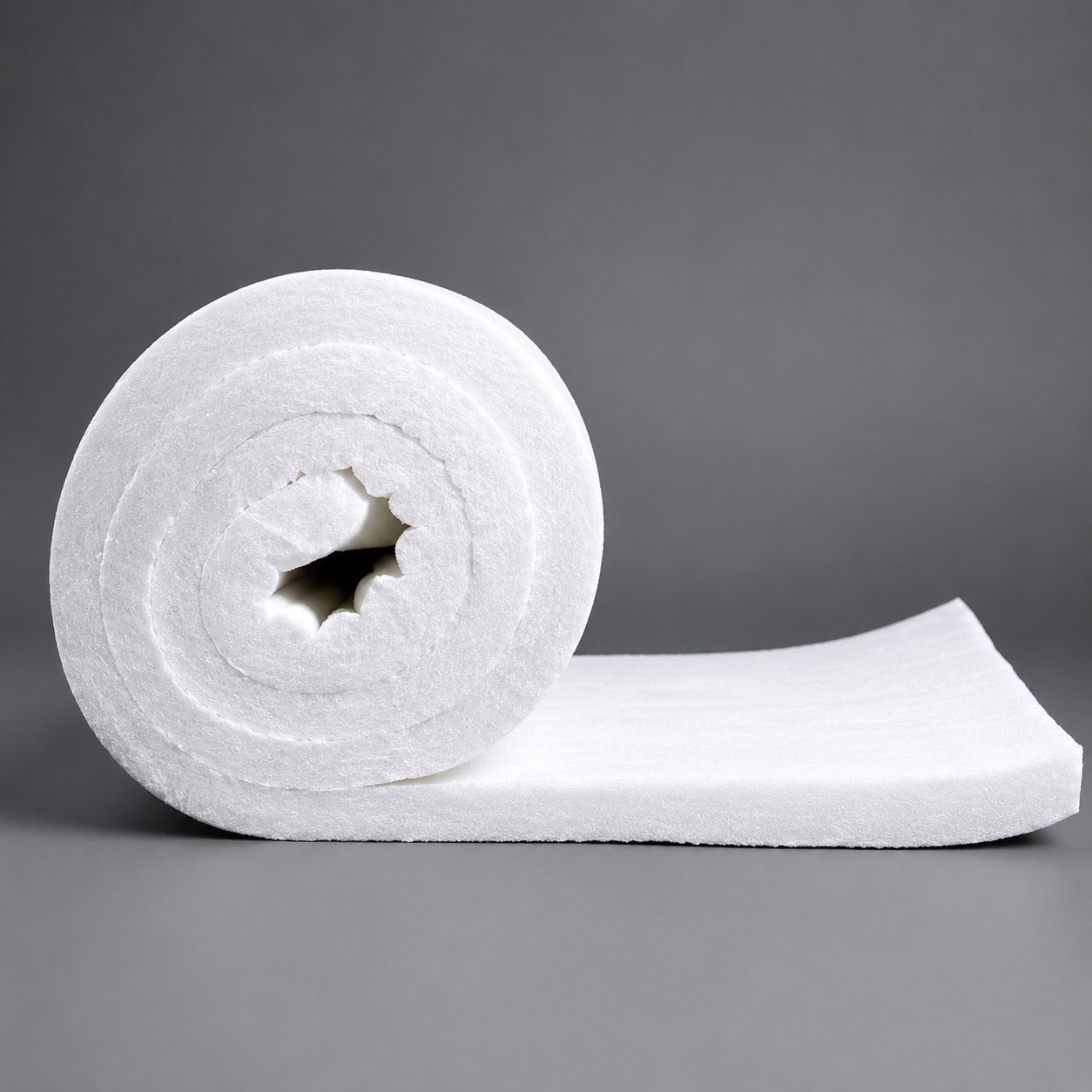
Ceramic Fiber Blanket
HIGH TEMPERATURE INSULATION

Ceramic Fiber Blanket

Standard ceramic fibers are made from inorganic materials, primarily Alumina, Silica & Zirconia, with long refractory fiber, which are binder free and are needled leading to very high thermo stability. Under normal circumstances ceramic fiber can be applied at 1260°C. It has very low thermal conductivity.

Ceramic Fiber Blanket is a lightweight, flexible, and high-performance insulation material engineered for extreme temperature applications. It offers outstanding thermal insulation, low thermal conductivity, excellent thermal shock resistance, and exceptional fire protection. Widely used in furnaces, kilns, boilers, ovens, and industrial pipelines.

High Temperature Resistant Low Thermal Conductivity Energy Efficient Thermal Shock Resistant Lightweight & Flexible Chemically Inert

Technical Specifications

Detailed physical, thermal, and chemical properties of Ceramic Fiber Blanket

Density 64 / 96 / 128 Kg/m³
Dimensions (W × L) 0.610 m × 7.3 m
Thicknesses 12 / 25 / 38 / 50 mm
Temperature Range 1260°C / 1425°C
Chemical Resistance Resistant except to Hydrofluoric & Phosphoric acids
Average Fiber Diameter 2.6 – 3.5 Microns
Property 128 Kg/m³ 96 Kg/m³ 64 Kg/m³
Thickness (mm) 25 25 25
Width (mm) 610 610 610
Length (mm) 7300 7300 7300
Thermal Conductivity (W/m·K) at 600°C 0.15 0.16 0.18
Tensile Strength (KPa) 65 Min. 50 Min. N.A.
Shot Content (%) 9 – 15
Linear Shrinkage at 1200°C (24 hrs) 2.5% – 3%
Appearance White / Visual Passes

Chemical Composition

Al₂O₃ 44.50 – 48.00%
SiO₂ 52.00 – 55.50%
Fe₂O₃ < 0.1%
TiO₂ < 0.3%

Applications

Ceramic Fiber Blanket is ideal for high-temperature insulation across various industries

Reformer / Heater / Furnace / Kiln Lining
Coke Ovens & Expansion Gaps
Thermal Barrier for Automotive Industry
Boiler / Ducts / Pipeline Insulation
Steam & Gas Turbine Insulations

Advantages

Key benefits of using Ceramic Fiber Blanket

Very thin and effective insulation
Low heat storage due to low density
Faster heating and cooling in furnaces, leading to higher productivity and fuel savings
Lightweight construction reduces furnace structure weight and cost
Easy to install
Good acoustic properties
Chemically inert with very low chloride content
Leachable chloride less than 10 ppm
Scroll to Top